In June 2022, Anita Alvarez finished her solo routine at the World Championships in Budapest, and her body simply stopped. She sank, unconscious, to the bottom of the pool. Her coach saw it happen, dove in fully clothed, and pulled her to the surface. The photographs went around the world. She came back to consciousness inside a story she hadn't chosen — strangers' opinions, viral images, a wave of feelings landing all at once. And underneath the noise was a quieter, heavier question that had nothing to do with her body. It was a decision. Was this the moment to walk away?
The Reframe
Part of her wondered if the scare was a sign that her time was up. She brought it to her coach, who offered another way to see the same facts: maybe it wasn't an ending at all. Maybe it was a challenge — the sport asking her to prove, to herself, how badly she actually wanted it. Same event, different frame, completely different decision on the other side of it. She chose to come back. Cleared to compete in early 2023, she returned with a goal bigger than herself: help bring Team USA back to the podium. That mindset — the refusal to read a setback as a verdict — is the engine of everything that followed.
“There are never any failures, never any negative moments — if you look at it from the right perspective.”
The Outside Voice
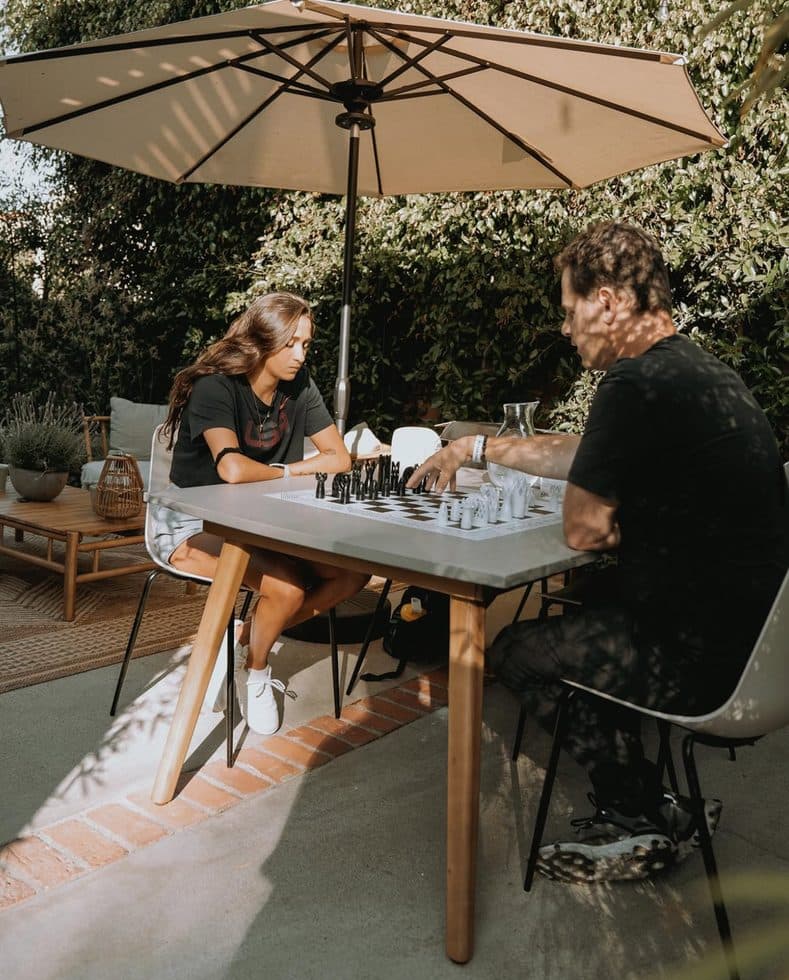
Somewhere in those years, Alvarez started working with Seth Makowsky. He isn't a swim coach — he has no association with her sport at all, which is exactly the point. When a challenge comes up, she talks it through with someone who can see the whole board from the outside, without the assumptions that come from living inside the pool. The work isn't about swimming. It's about how she thinks, and how she decides. Makowsky's tool is a chessboard, and the premise is simple: every move in chess is a decision. A single game throws a hundred of them at you — fast, with consequences, an opponent answering back every time — so an hour at the board is more practice at deciding than ordinary life hands you in months.
“Chess is concentrated decision-making.”
Train that deliberately, and it transfers to wherever the real decisions get made — including thirty feet from the surface, mid-routine, with a medal on the line.
The Process
In the sessions, Makowsky runs Alvarez through the same framework he uses with every athlete: control the center, develop your pieces, protect the king — then refine the middle game while never taking your eye off what you're really protecting. On the board, he even calls the pieces “swimmers,” because the mapping is the entire point. When he wants her to commit a bold move — sliding the queen in right beside the king, the kind of aggressive choice most players flinch at — he frames it the way she'd read it in the water: two swimmers working together, covering each other.
The lesson underneath it is process over talent. A swimmer running on raw talent alone is brilliant some days and off others. A swimmer running on a process is repeatable. When you're not sure what to do, you don't freeze — you fall back on the process, and it points you to the move. It's hard to beat someone with a process. And then it compounds.
“It's hard to beat someone with a process.”
The Switch
The change Alvarez points to is specific. She used to agonize over choices — turning them over endlessly, slow to commit, in her own words terrible at making decisions. Through the work, that wiring flipped. She learned to read a situation and act on it: to think on the spot and make the big call instead of stalling on it.
“I would always ponder on something forever — that really switched in me.”
And here's the part that matters most: deciding faster is what let her lead. A team can't follow someone who freezes at the fork. Once she could step in and make decisions under pressure, she became the leader her team needed — the veteran voice steadying a roster full of first-time Olympians.
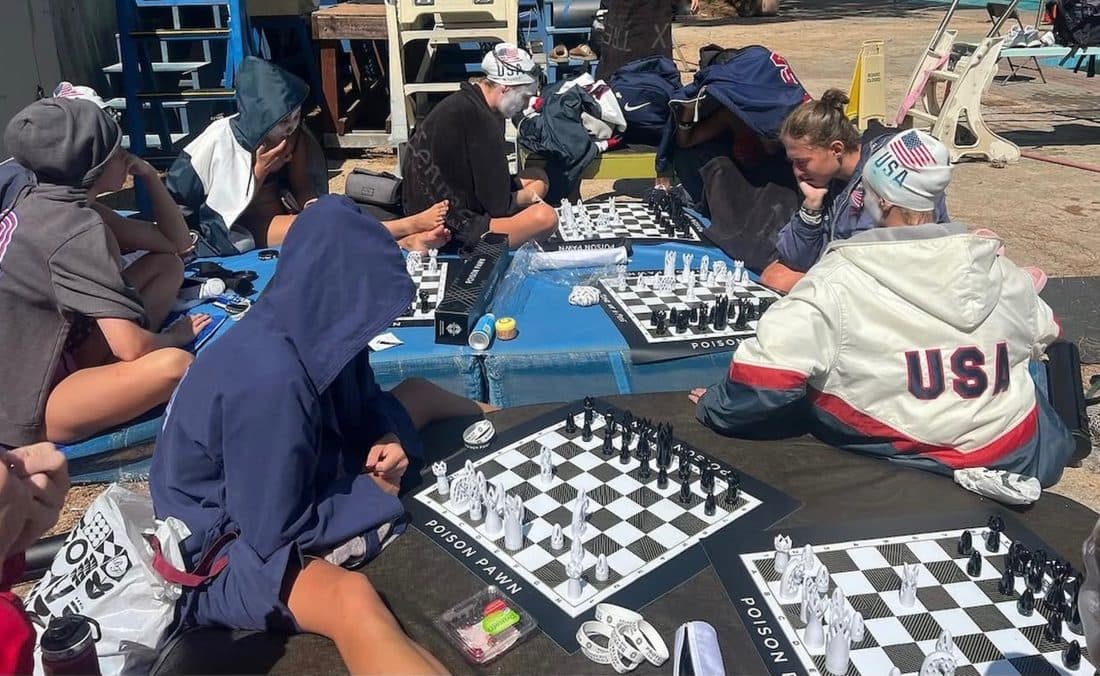
Team USA Artistic Swimming training with Poison Pawn boards poolside ahead of Paris 2024.
The Team
The work spread to the whole roster. Ahead of Paris, the Team USA artistic swimmers sat down around the Poison Pawn boards together — poolside, between sessions — training the same muscle as a unit: reading the position, weighing the options, committing to the move. For a sport judged on eight athletes thinking and acting as one, decision-making isn't a side skill. It's the event.
Two Years Later, the Podium
At Paris 2024 — two years after Budapest — Anita Alvarez became the first American ever to make three Olympic teams in artistic swimming. Then she and Team USA did what no American squad had done in two decades: they medaled, taking silver in the team event for the country's first Olympic artistic-swimming podium since 2004. Their routine, an upside-down underwater moonwalk, went viral around the world. She now holds four World Championship medals. And she isn't finished — she's training toward Los Angeles 2028 and a fourth Olympic Games, this time with her sights set squarely on leading.
A Poison Pawn feature on decision-making under pressure, drawn from interviews and training sessions with Anita Alvarez and Team USA Artistic Swimming. Career details via public reporting on the 2022 World Aquatic Championships and the Olympic Games Paris 2024. Player, not a piece.®