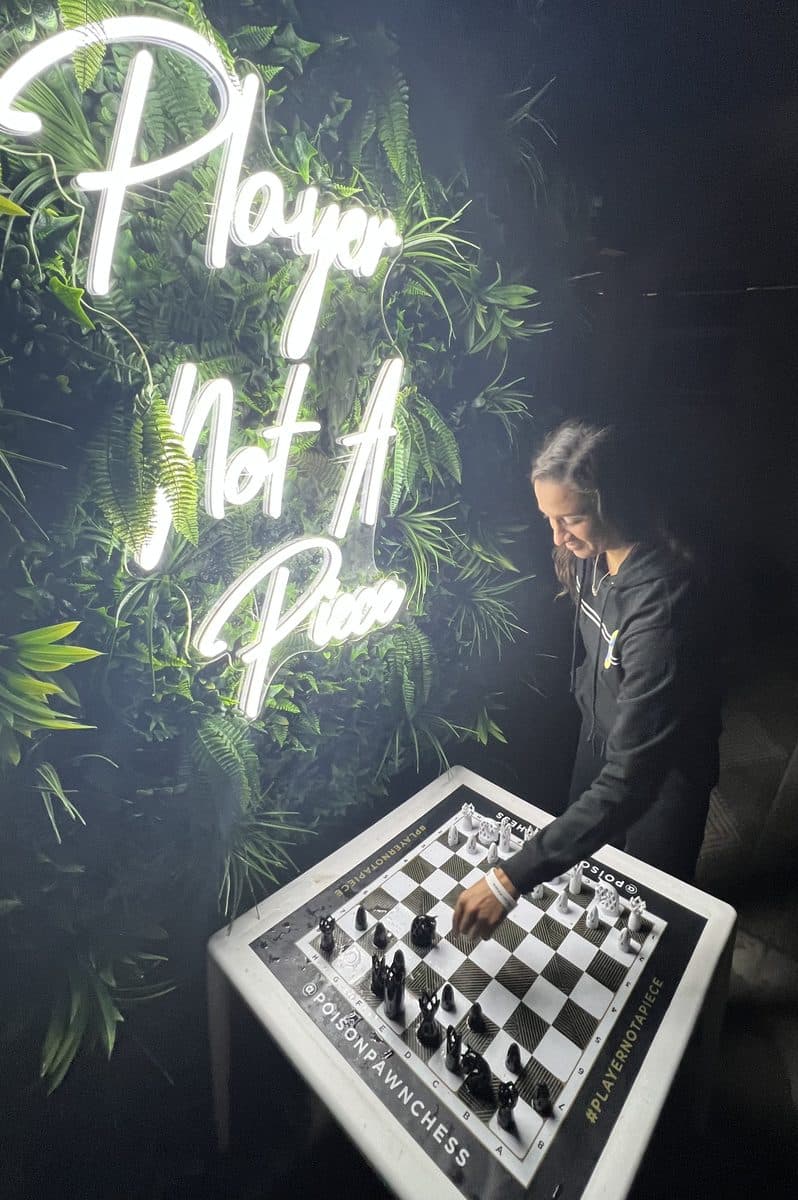
There is no locker room here, no whiteboard, no clock winding down — just a glass table on a terrace above Los Angeles, two chairs, the city stretched out below, and a set of sculptural black-and-white pieces catching the afternoon light. Across the board from Seth Makowsky sits Cameron Diaz — and the point of the afternoon was never to make her a stronger chess player. It was to show her something about herself. The same decision-training method Makowsky runs with NFL quarterbacks and NBA champions, here applied to someone the world knows from screens, not stadiums. The afternoon was about one thing: how a person decides when it counts.
The Premise
The idea behind Poison Pawn is simple. Every move you make in chess is a choice — and a single game can ask you for a hundred of them, fast, with real consequences and an opponent answering back every time. An hour at the board can give you more practice at deciding than ordinary life hands you in months.
“Chess is concentrated decision-making.”
Train there deliberately, and the skill carries to wherever decisions actually get made. The game is never the destination — it's the rep. Which is why, after years of the work with Makowsky, Diaz stopped describing the board as a game at all. She came to call it something closer to home — “a metaphor for life” — not because chess is profound on its own, but because the method kept turning every session into a clear read on how she thinks, how she decides, and how she recovers when a move goes wrong.
The Mirror
What keeps Diaz at the table isn't the game itself — it's what the game reveals. Each session, she says, gives her something she can't get anywhere else: not just chess knowledge, but a clear read on her own strengths and weaknesses. Then she carries it into her week. She catches herself making the same move in life that she just made on the board — rushing, or forcing a line, or spiraling after one mistake — and recognizes it for what it is.
“I learn so much — not just about the game, but about my own strengths and weaknesses.”
The practical lesson is almost embarrassingly simple, and that's the point: take a second, breathe, look at everything. What she's really training is what Makowsky calls the collapse point — the instinct to keep one thing going wrong from becoming many. One bad move doesn't have to cascade. You notice it, you reset, you keep the position whole.
The Work
What Makowsky trains is a framework — mental models and a checklist that run before a move, so the errors that come from rushing drop toward zero and every move becomes a deliberate choice rather than a reflex. Through the session he keeps returning Diaz to the same beat: when you see a move, don't grab it. Take the extra second. Is there anything better?
“It's just a muscle that we want to get a little stronger.”
Why It Matters Off the Board
One of Diaz's real strengths, Makowsky notes, is spontaneity — the ability to make quick, instinctive decisions. The goal was never to dull that. It was to keep the gift intact and add a beat of deliberation at the moments that carry weight: a contract, a business decision, a fork in the road that can't be redone. Keep the impulse where it serves her; slow down where it doesn't.
And here is why a chessboard above Los Angeles says something real about Cameron Diaz. This is a person who, at the height of her career, deliberately stepped back from acting to look at the whole picture and decide what was actually worth doing. Who co-founded Avaline — a clean-wine company she was told couldn't be built — and made it her primary focus. Who returned to film, on her own terms, only when it served the life she'd designed. That is not a spontaneous personality being reckless. That is exactly the player Makowsky describes: the instinct preserved, the big decisions taken slowly and on purpose.
Cameron Diaz training with Seth Makowsky · Los Angeles
“It was never the chess. It's how you decide.”
A Poison Pawn feature on chess as decision-training, drawn from a session with Cameron Diaz in Los Angeles. Player, not a piece.®