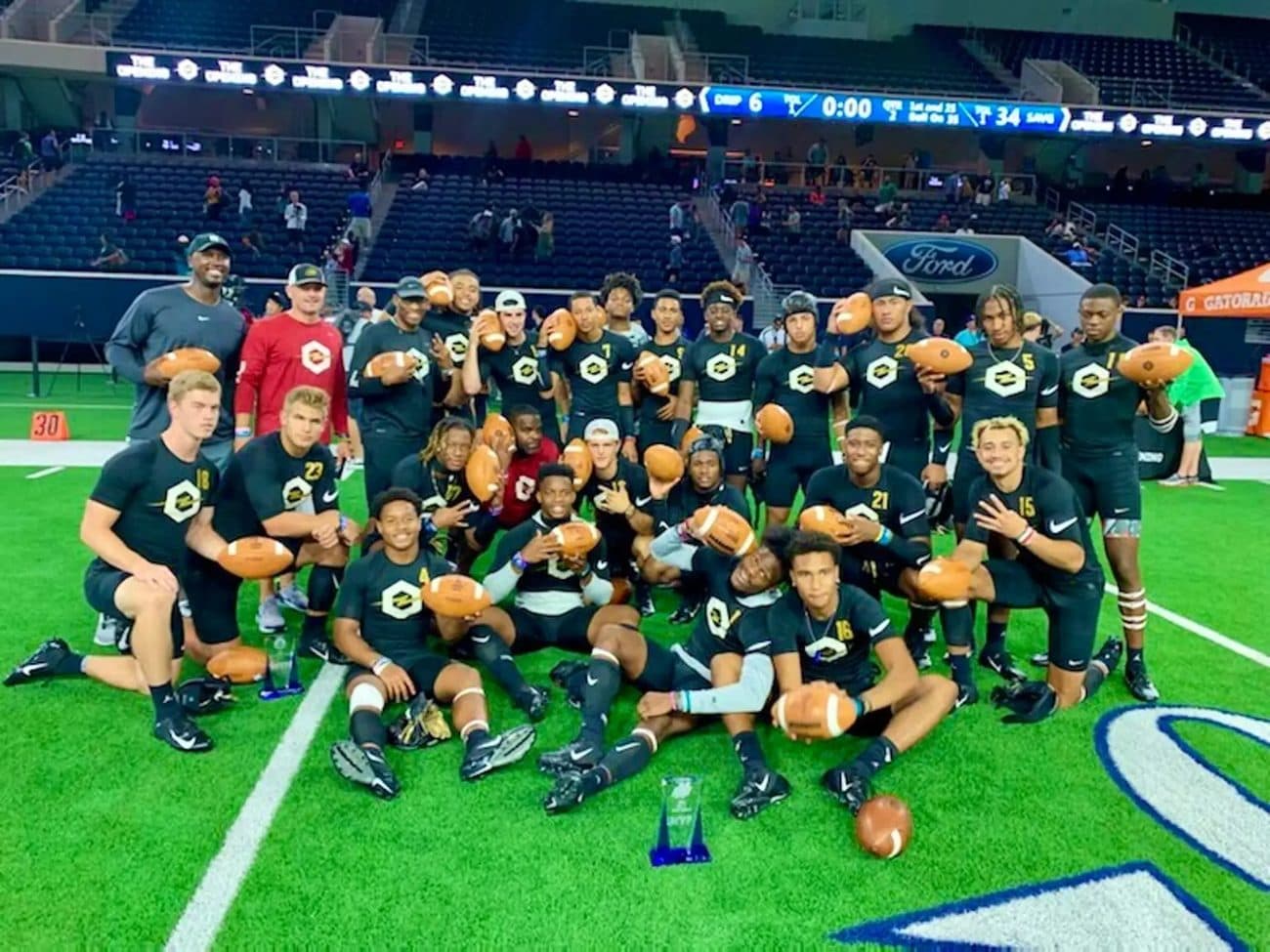
The buzz didn’t take long to spread throughout the whole football camp. Coaches who always are searching for the next big thing — or better still, that one player flying under the radar — began asking each other, “Who is the unheralded kid killing it?” Players were even more direct, talking to each other about the “three-star kid” dominating the camp competition. Even the NFL guys in attendance to help drop some pointers had begun to gush.
That camp was a 2019 Nike-sponsored event called The Opening and it was being held at The Star, the Dallas Cowboys facility in Frisco, Texas. Some 200 of the country’s top high school seniors had flown in for the event. Among that group were two dozen quarterbacks who had been invited to the Elite 11 based on their performances at a series of regional workouts. Some, like five-star quarterback Bryce Young, arrived with fully formed reputations. Most of the quarterbacks were blue-chippers who’d already been wooed by college coaches and picked their schools.
C.J. Stroud, who’d come up in the shadows of Young and fellow uber-prospect DJ Uiagelalei in Southern California, was the outlier.
But when the 7-on-7 competition got into swing, it was Stroud, not Young, who was the quarterback on Team Savage that everyone couldn’t take their eyes off. Stroud looked surgical, carving up defenses. The ball barely hit the ground.
Julian Fleming, one of the go-to receivers on Team Savage, approached one of his friends on a different team — fellow Ohio State commit Jaxon Smith-Njigba. Fleming simply said, “Hey, C.J.’s like that.” Both future Buckeyes then chatted up Stroud, who at the time had a handful of Pac-12 and Mountain West offers. Stroud told them he was not really sure where he should go.
After Smith-Njigba walked away, he and Fleming called Ohio State coach Ryan Day. “I said, ‘We need to get this guy. He’s special,’” Smith-Njigba told The Athletic.
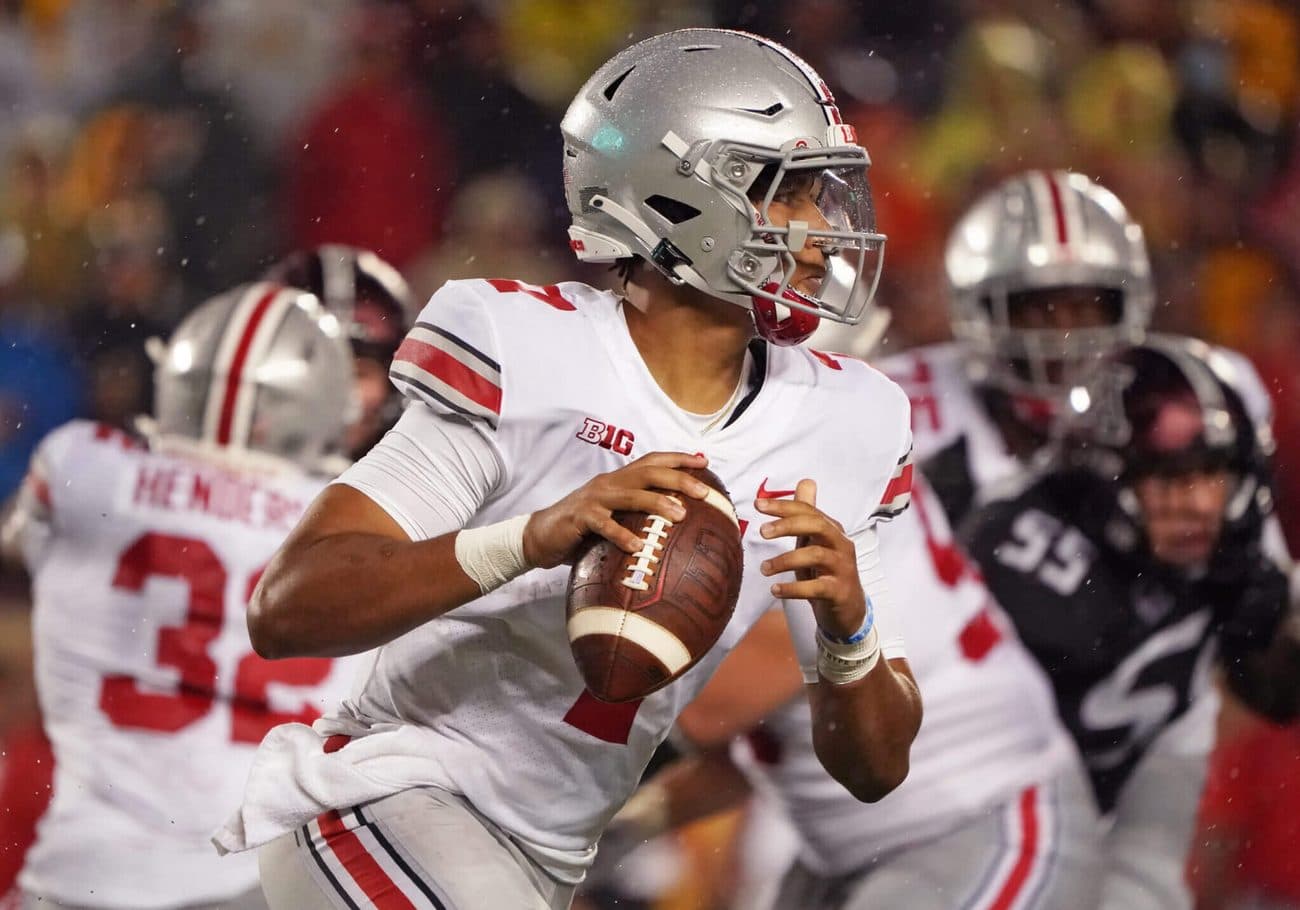
Last season, Stroud dazzled as Ohio State’s first-year starting quarterback, completing 72 percent of his passes to go with a 44-to-6 TD-to-INT ratio. Against ranked opponents, he was even sharper, completing 75 percent with 17 touchdowns and just two picks. Over the Buckeyes’ last four games of the season, Stroud completed almost 80 percent of his passes. In this year’s season-opening win over No. 5 Notre Dame, Stroud was 24-of-34 with two touchdowns despite being without Smith-Njigba, his go-to guy, for much of the night.
A Heisman favorite — perhaps an even more attractive draft prospect than Young because he is 3 inches taller and about 30 pounds heavier — Stroud’s rise to stardom has been an interesting one, but it’s his origins story of his breakthrough week in Texas that gets to the core of what makes him so special.
Unlike many of the top young quarterbacks, Stroud didn’t have a private coach who had been grooming him for years before he became a high school starter. When Stroud attended his first Elite 11 regional camp, it was a rainy day in Los Angeles. The Rancho Cucamonga, Calif., product caught the eye of the coaches in spite of the sloppy conditions. He then traveled to Oakland for a second regional camp, where he was even more impressive.
“We loved that he came back for his second regional,” said Joey Roberts, the Elite 11’s director of scouting. “Quarterbacks are interesting. If they don’t have instant gratification, an instant on-site invite, a lot of them take their ball and go home. He showed up to compete in Oakland. Public perception-wise, Southern California always focused on Mater Dei and Bosco — i.e. Bryce Young and DJ Uiagelalei — which, looking back on it, allowed for C.J. to develop at his own rate and naturally have a target up on the mountain to aim at in his own backyard.”
Roberts also liked the fact that Stroud’s high school started his junior year 0-4, but he never lost the locker room and the team went on to win seven games in a row.
The Elite 11 Finals were held in Texas in 2019 and carried into The Opening, where 7-on-7 teams were set up. Former NFL player-turned-pro scout Bucky Brooks was the coach of a team that had both Stroud and Bryce Young. At the event, one of the resources offered to the players was Seth Makowsky, a chess master who has helped business executives use the principles of chess in their own lives. Brooks, a self-described perfectionist who always lamented being too analytical and often stuck in his own head, was intrigued by Makowsky’s approach and the way he taught. Turned out, so was Stroud.
“Will you train me after this?” Stroud asked Makowsky. Stroud met with Makowsky from 10 p.m. to midnight for a couple of nights. They worked on having a plan and a process, knowing what the threats are and what to attack. From that perspective, Makowsky was teaching Stroud to process how all of the pieces — and players — worked together in a complex environment, and seeing the entire board. Or the field. Brooks said that it was “a mind-blowing” experience for a lot of these kids.
“For C.J., it allowed him to come to the line and have a check off process,” he said. “It gave him a way to organize his thoughts in the moment, without making it bigger than it is. And when it clicked, he was all in. He ignored all the white noise of the other kids laughing. You could just see that it unlocked him.” The mindset Makowsky showed them was: “Hey man, simple is better. Less is more. Don’t overthink it. See it. Be it. Let it go. You’ll always have an answer. You’ll never be surprised.”
Brooks was amazed as Stroud transformed. “His confidence was growing. The ball is not hitting the ground. He’s hitting the check downs. Everything. Every play finished with a completion. He didn’t try to do too much, which is hard for guys there. Can they be patient and disciplined enough to take what the defenses is giving you? That’s hard for a teenager. But he was so hot, we were blowing people out. (Opponents) hate seeing the ball completed. As soon as they come up, boom, he throws it over their head and hits them with the big play. Big dime balls down the boundary.
“C.J. understands that simple game within the game. The arm talent was crazy. He was pushing the ball down the field. He was playing chess from the pocket.”
The kid who arrived in Texas that week as the No. 25 pro-style quarterback in the 2020 recruiting class torched every defense he faced, completing 81 percent of his passes and throwing 12 touchdowns — and winning MVP honors.
Brooks, who also coaches high school football in Southern California, said he calls plays to try and get the young QBs to play against their own egos. “Most of them can’t resist the urge,” he said. In that format of 7-on-7 football, incompletions turn into second-and-20 situations. “It’s hard for them to stay patient.” Not Stroud, though.
“It definitely helped my game,” Stroud said. “If I move this here — it’s just like, about life. If I move this one way, something else can happen. You could get captured or whatever the case may be. It definitely helped me. My arm was hurting, but I didn’t really care. I wanted to show out. I took it as an opportunity for me to show the world what I could do.
“That week was what changed my life.”
Stroud admits that in spite of how he might’ve looked, he was “not confident at all going into it.” He added: “I didn’t know what I was gonna do (or) how I was gonna do it. I knew that I had talent, but I’d always been in Southern California. I didn’t know that we had the best quarterbacks. I went in with the approach, OK, I’m just gonna do me and just do what God called me to do.”
In the Elite 11 staff’s postmortem of the young quarterbacks, their comments on Stroud were about the quarterback’s “thirst to learn” and how he was the “hungriest kid” there.
Roberts said he recalls Stroud “spending every waking hour either with (former NFL QB) Jerrod Johnson (now a Minnesota Vikings assistant), asking questions, or playing chess with Seth Makowsky. He didn’t grasp the intricacies of chess early on, but he didn’t quit. We’ve had quarterbacks who get flustered and just shut down because they are never used to not being the alpha.”
A few months later, Stroud committed to Ohio State even though the Buckeyes already had a commitment from Jack Miller, who had been ranked as the No. 3 pro-style quarterback at the time of the Elite 11. None of the coaches, and perhaps none of the players who were in Texas that week and witnessed Stroud’s metamorphosis, were surprised that Stroud emerged from a four-man quarterback battle to win the job in 2021. Or that he became a Heisman Trophy finalist in his first season as a starter.
Stroud finished the 2021 season not far from where he grew up, playing in the most storied venue in football, the Rose Bowl, and leading Ohio State to a thrilling win over Utah. He set five Rose Bowl game records as he threw for 573 yards and six touchdowns. Life has changed a lot for the 20-year-old.
“It’s been amazing for me,” he said. “It’s definitely been different. To me, this is what God called me to do. It’s been a blessing because this is what I asked for. I appreciate God for blessing me with all these different things but at the same time, I need to stay focused.”
Brooks, putting on his NFL scouting hat, said he sees in Stroud a better version of the breakout star he coached three years go. Stroud’s gone from 6-foot-2, 190 pounds to 6-foot-3, 225 pounds. “He’s fully grown up,” said Brooks. “When you look at the position, he’s what you’re looking for. (He’s) a polished pocket passer, but he’s athletic enough to also do the other stuff that you need.”
A lot is coming fast at Stroud. He has a marketing rep and an agent to help with NIL opportunities. There are so many things out there that intrigue him. After football, he said he’d like to be an actor. “I want to be like Shaq,” he said. He’d also like to go into coaching so he could work with kids.
And when asked how hard it is to stay in the moment, when it seems like he’s become a big star almost overnight, he said: “It would be (hard), but I’m so grounded in my faith and I thank God that I have that to where I just try to remain humble. I appreciate God for making me that way and I realize that anything can be gone tomorrow so I have to cherish it while it’s here.”
Originally published by The Athletic, Bruce Feldman · Sep 5, 2022.
Read the original at The Athletic →